

Hello all, my name is João and until my eighth grade I was one of those kids who didn’t enjoy sports at all. I cycled through a couple of them now and then, but none of them actually made me feel anything. Until one day a good friend of mine asked me if I wanted to go to a lunch time handball practice, and from that moment on, everything changed. I spent the following decade playing handball at different competitive levels, and fell in love with the sport.
My final school season was a special one. Me and my teammates finished first and climbed all the way to the national first division. A school team, in the top flight. When the season ended we all left for university, the big clubs came shopping, and a couple of friends and I landed at Os Belenenses FC, where I spent two years playing professionally as a pivot.
Eventually I traded the resin on my hands for a keyboard. And the longer I work in engineering, the more it feels like the same job with worse cardio.
Handball in 60 seconds
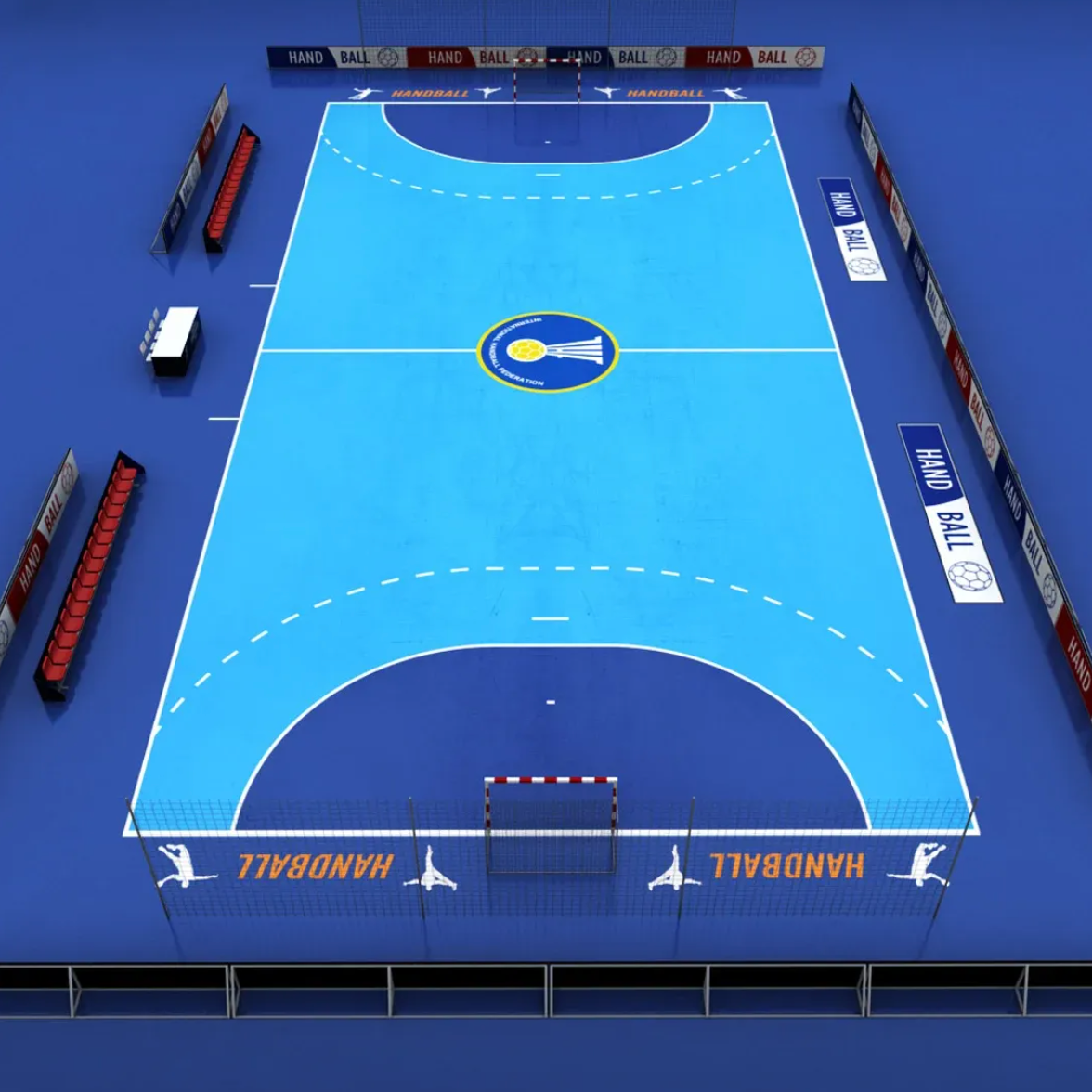
No problem if you’ve never watched a match, I got you covered. Seven players a side, 60 minutes, a goal roughly every minute, so final scores look like 31 to 28. Fast, physical, and tactical: every attack is a designed play with a name (jugo, central-pivot, pingo doce to the right), every defence is a coordinated system (5:1, 1:5, 6:0), and substitutions roll constantly.
The rest of this post is me realising, one habit at a time, that my old coaches were doing engineering management all along.
Every position has a job description
Ask me what any engineering role does and I'll answer with a handball position.
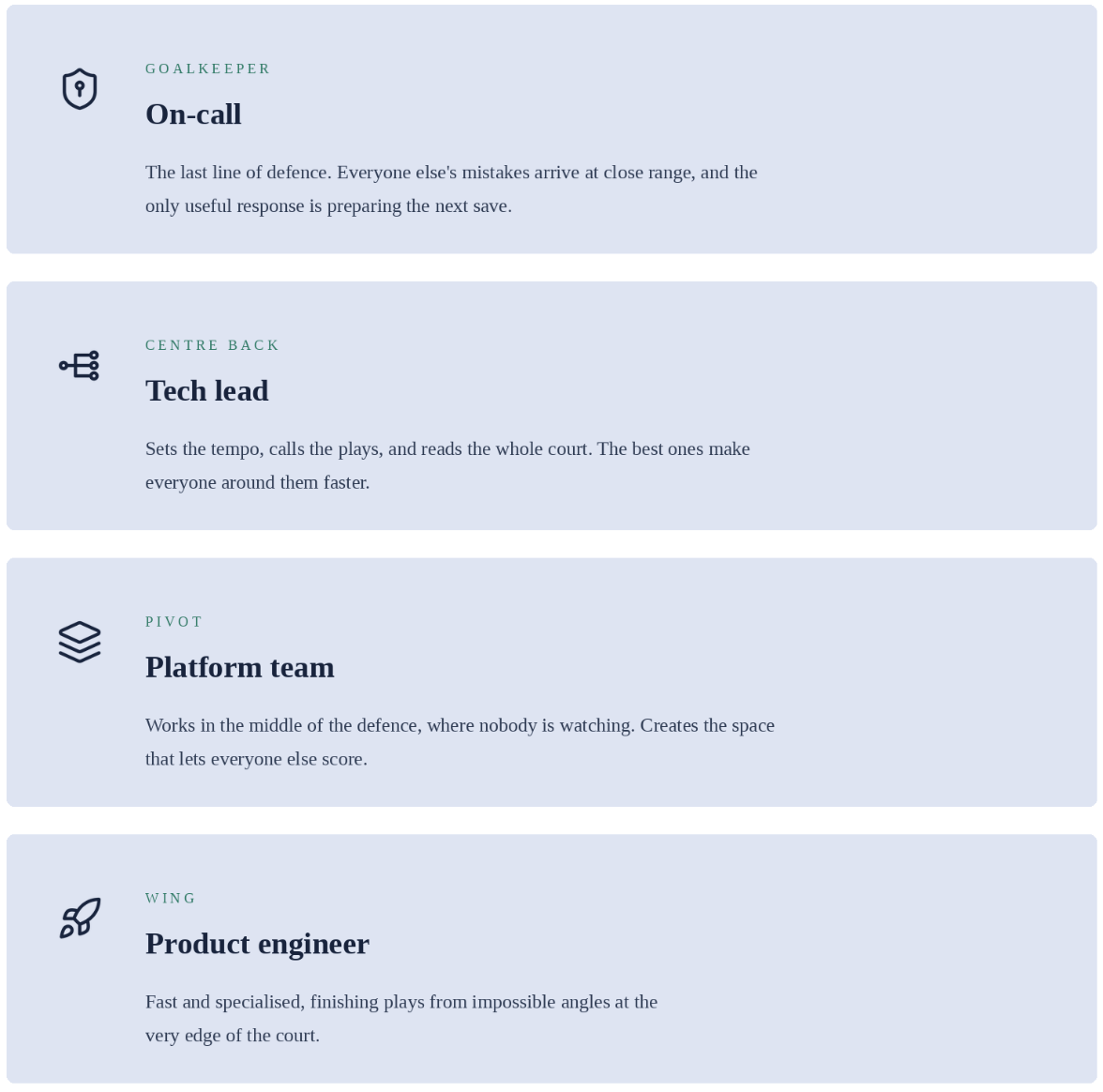
The goalkeeper is on-call. Last line of defence, and everyone else's mistakes end up in front of you. Ever been paged at 3am for something you didn't write? Then let me tell you that you’ve been a handball goalkeeper.
The centre back is the tech lead. Sets the tempo, calls the plays, reads the whole court. The best centre backs I played with were rarely the strongest athletes. Look at some of them and you'd think, “are they even in competitive sports?” But they made everyone around them faster.
The wings are the product engineers. Fast, specialised, finishing plays from angles that look impossible.
The pivot is the platform team. You play with your back to the goal, buried in the middle of the defence, and your entire job is to create space so other people can score.
I played pivot for years, and today I work on the Migration Tooling Team.
The block moves together
A handball defence is six players moving as one block, shifting together and closing space as a unit. Opposing teams’ brilliance rarely beats the block. Gaps do. And the gap almost always appears the same way: one defender decides to be a hero, breaks formation to chase the ball, and the attack plays straight through the space they left behind. Attacking teams engineer this on purpose. The French call it décalage: discrepancy.
Software Engineering teams get beaten the same way. The dangerous moments are rarely the hard problems. Reviews, pairing, and clean handovers can feel like a process for its own sake. They're not. They're the block moving together, so no single gap, and no lone hero, decides the outcome.
Limitations are not failures
Handball has no cap on substitutions. Players rotate dozens of times per game, but only seven can be on the court at once. So you wait at the side line, watching your teammate sprint toward you, and you don't step on until they're fully off. Put a foot down a second too early and, if the referee sees it, you sit for two minutes while your team plays a player down.
Nobody argues the limit is unfair. Nobody pretends it isn't there. Everything about how a team operates, its rotations, its timing, is designed around it.
All that rotation exists because of a second, more human limit: very few players are genuinely great at both attacking and defending. Attack rewards explosiveness and creativity; defence rewards positioning, anticipation, and comfort with contact. So teams substitute specialists constantly. Every few years someone like Mathias Gidsel shows up, elite at both. Most teams don't have a Gidsel, and they win anyway. The sport doesn't demand complete players. It demands complete teams.
Good engineering runs on the same honesty. Mature services publish their limits: rate limits, throughput ceilings, operations they deliberately don't support. Exceed them and you get throttled, the same way an early foot earns two minutes.
And (almost) no engineer is elite at everything either. A team that pretends otherwise gets heroics, burnout, and single points of failure. A team that admits it gets a rotation, and that’s fine.
The seven-meter throw
Watch a professional take one and they look unnaturally calm. That calm is trained, and I can tell you exactly how. You rehearse: thousands of repetitions of the same throw until your shoulder aches (I’ve been there), so the big moment feels like one more. You follow a routine: same steps, same order, every time. Bounce the ball, breathe, look at the same corner. Score or miss, play restarts in seconds and demands your full attention.
That's runbooks and game days. That's the deploy checklist you follow even when you're sure. That's shipping or rolling back and giving the next task a clean slate. Pressure never left my life after handball. It just changed shape, from a hall gone quiet to a feature that needs to ship.
The ten seconds after a mistake
Here's a number my coaches gave me that I’d like to underscore: a handball team loses the ball around 9 to 13 times per game. Every game, including the best teams in the world. Losing the ball is part of the game. What matters is the ten seconds after.
When you lose the ball, the counterattack is arriving now. So players train a short memory: sprint back, defend, analyse later. Standing still to feel bad about the mistake costs more than the mistake did.
Incidents are our turnovers. A bad deployment, a stuck workflow, and the temptation is to freeze, or to start asking why while the system is still on fire. Handball's answer: stabilise first, root-cause later. Sprint back, defend the goal, save the analysis for when the ball is safe.
Match tape is a blameless postmortem
Which brings me to where the analysis happens. After every match we sat down as a team and watched the tape. I've seen this from both sides: from my second year of university until the end of my master's, I went back to my old school and coached the youth teams. I've been the player on the sofa and the coach looking at the players.
A good tape session never asks whose fault a goal was. That question teaches you nothing except who to blame. It asks which system broke. Was the block set? Who should have covered? What changes before the next game day?
Coaching teenagers taught me why framing matters. The moment tape review becomes about blame, players start hiding. They stop being honest about what happened, and you lose the one thing that makes the next match better.
Retrospectives are the same. Question the system before the person. The tape doesn't lie, and neither do the logs. The only variable is whether people feel safe enough to look at them honestly.
Playing one player down
One more rule. Commit a bad foul and you sit out for two minutes while your team plays six against five. This happens several times in every game, so good teams don't treat it as a crisis. The system is designed to hold while it's a player down.
Work is no different. Holidays, sick days, people moving on: somewhere, you're always temporarily a player down. Documentation, runbooks, and shared context are how the block holds until everyone is back.
I lived a personal version of this rule. In my second year of university, my grades made it painfully clear I couldn't hold professional handball and a degree at the same time. So I rotated myself off: I left the professional game and kept playing for fun in other leagues. It was a hard call, and it still stings a little. But knowing when you're the player who needs to come off is a skill too. Sustainable teams, and sustainable engineers, run on honest capacity, not heroic overload.
What I carry from the court
Three habits came with me from handball, and I try to bring them to work every day.
Roles beat heroes. Clear positions and trust in the next player win more matches, and ship more software, than individual brilliance ever will.
Pressure is practised. Calm under fire comes from repetitions, drills, routines, and runbooks, not nerves of steel.
Recover fast, review honestly. Short memory during the game, honest tape review after it.
Handball taught me that good teams make just as many mistakes as everyone else. The difference is they've already decided what happens next: who covers, what the routine is, how the review goes.
As for me, I never actually stopped playing. I founded an alumni team back at my old school, and I play for my university team through the end of this season. The court and the codebase turned out to be the same place after all.